





A Quantum Leviathan Under The Economist’s Cover: How a "Deal" with the Kremlin is Being Prepared Behind Our Backs
Analytics | 10 July, 2026 at 12:40 | 2,366 | Author: Olena Zelenina, Olexandr Sydorenko (caricature)
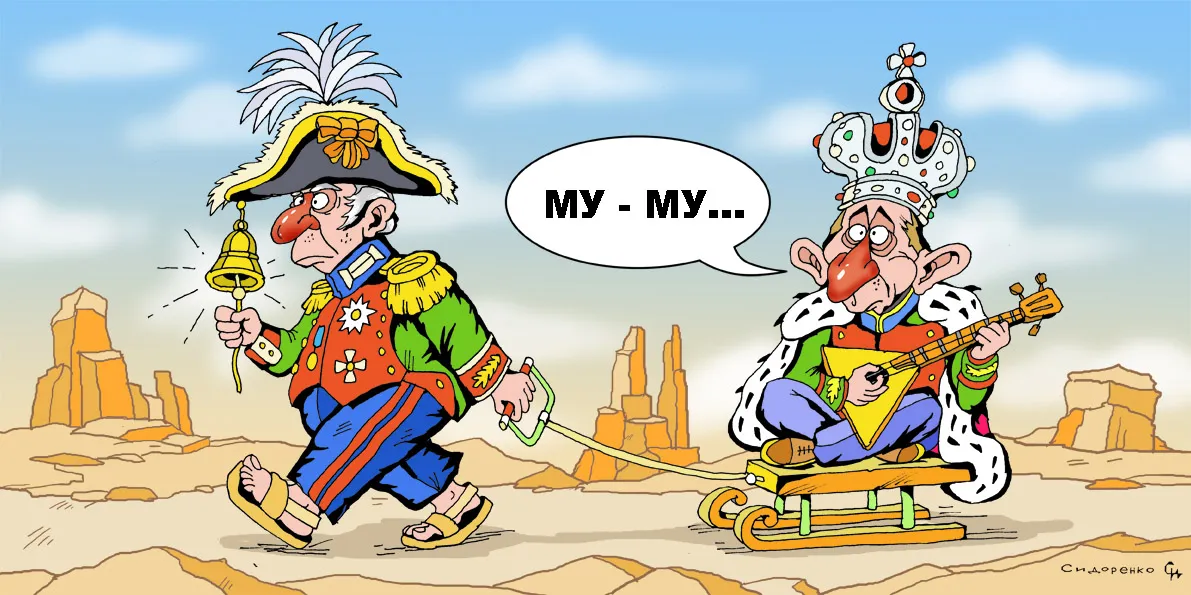
Cartoon by Olexandr Sydorenko.
While Kharkiv, Kyiv, Odesa, and other Ukrainian regions withstand the onslaught—under sirens, going hours without power, scraping together their last hryvnias for frontline drones—a completely different war is being waged on the closed diplomatic floors of Washington and London. A war of meanings. And the Kremlin’s goal here is to force the West to capitulate, but in a way that makes European and American politicians sincerely believe they are buying "shares in a new, sane, and peaceful Russia."
Recently, the British magazine The Economist—the bible of the global political establishment—fired a powerful triple volley dedicated to the sanctioned Russian oligarch, Andrey Melnichenko.
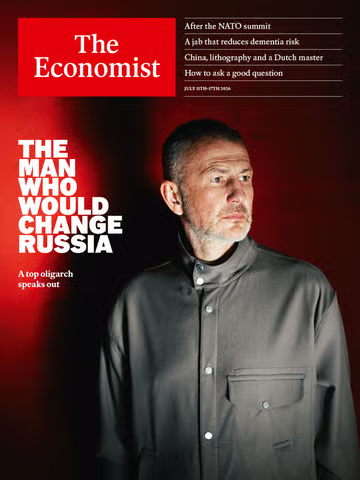
Just look at this cover.
The planet's premier business weekly comes out with a large photo of the Russian billionaire. Dramatic lighting, the image of a sleek technocrat, and a screaming headline across the entire page: "The man who would change Russia. A top oligarch breaks his silence."
This is not just a publication; it is the absolute Everest of Kremlin lobbying. On the exact same day, July 9, 2026, the outlet released:
A massive feature-length profile of Melnichenko, written by the editor of the Russia and Eastern Europe bureau, Arkady Ostrovsky, under the headline "A top oligarch breaks his silence".
The personal manifesto of Melnichenko himself in the By Invitation section: "Why a broken Russia is bad for the world" .
And most importantly—the editorial leader in the Leaders section: "The man who would change Russia" .
To understand the inner workings of the media: the Leaders section in The Economist is the holy of holies. It represents the official stance of the entire editorial board, the collective mind of the London office.
There, the editorial team signs off on its own helplessness, officially admitting: they spent nearly 60 hours interviewing the sanctioned oligarch! In other words, London analysts spent weeks listening to Putin’s emissary, allowing the Kremlin to turn Moscow’s covert ultimatum into the main theme of the issue.
To the average Ukrainian, the names Melnichenko (not to be confused with the infamous "Melnichenko tapes" of the former security major) and Ostrovsky mean nothing. But this triple volley concerns every single one of us.
A False Bottom:
A Mandate Straight from the Top
It all began neither in London nor in Istanbul. This tectonic media dump was preceded by direct coordination at the very pinnacle of the Russian vertical.
Andrey Melnichenko is number one on the Russian Forbes list (2023), a billionaire, and a graduate of the Physics Department of Moscow State University (MSU). He is not a banal thug from the 90s, nor is he a general with gold braids. He is a systems man who built a global commodity empire on fertilizers and coal.
In his conversation with Arkady Ostrovsky in Istanbul, Melnichenko openly boasts: he was personally received in the Kremlin by Vladimir Putin. And at midnight, right in his dictatorial office.
Consider the level of cynicism. A sanctioned oligarch flies in to meet a top Western journalist and immediately lays down his ace on the table: "I am straight from the First." This is a demonstration of a direct mandate. Why did the Kremlin need him specifically, when they have the proven Kovalchuks or the eternal negotiator Abramovich? Because Abramovich is too tainted by the selfish rescue of his personal billions; no one in the West believes him anymore. Melnichenko, however, is the ideal icebreaker. An intellectual who knows how to speak to the West in the language of risks.
Perhaps in the Kremlin he received a clear assignment: to package Moscow’s harsh, unpalatable demands into an elegant wrapping of systems analysis. So that the West would swallow the bait. Here are excerpts from his manifesto:
"The roots of the conflict lie partly in a structural imbalance that persisted in Europe after the cold war: Moscow’s security concerns were heard but never seriously addressed. After the political upheavals in Ukraine in 2014, Russia concluded that diplomacy had exhausted itself, and then it acted—first in Crimea, and then, eight years later, in four eastern and southern regions of Ukraine."
"The choice before the world is not between love for Russia and hatred of it... It is between two kinds of future: one in which great powers relearn to respect each other's sovereignty, and one in which each tries to reduce the others to objects of management."
If we translate these "profound thoughts" from political-science jargon into human language, the essence of the message is this: Russia’s sovereignty means "I do whatever I want." If I want to annex territories, no matter the casualties, I will. Do not interfere, because it will be worse and more unpredictable (for extra persuasion, the oligarch even mentions that he lived near Chernobyl during his childhood).
An Historical Trap
for Cambridge Intellectuals
Who exactly is the author of the profile, Arkady Ostrovsky? He is a deep intellectual with a Ph.D. in English Literature from Cambridge and the author of the book The Invention of Russia, for which he won the Orwell Prize. Ostrovsky also created the podcast Next Year in Moscow, where he desperately searched within Russian circles for a "peace party" and pragmatists capable of stopping the madness.
And this is precisely where the Kremlin caught him. When Melnichenko tells the journalist: "Among the elite, there is certainly a desire for someone to give voice to what everyone is already thinking. Perhaps it takes just one person to break the silence and open the floodgates," a trigger goes off in Ostrovsky's mind. He is mentally programmed to look for "Perestroika 2," and therefore sees the oligarch not as a Kremlin courier, but as a "man of ideas."
The British editorial team became so enthralled that they swallowed the historical bait as well. In The Economist’s editorial, they in all seriousness compare Melnichenko to the Russian industrialists of 1905, who, following the defeat by Japan, forced Nicholas II to sign the October Manifesto and limit absolute rule. The London journalists genuinely believed that standing before them was a new "leader of an oligarchic rebellion" who had come to reform Russia.
60 Hours of Quantum Blackmail:
A Trap for the Western Mind
The Russian oligarch turned on his full intellectual hypnosis. Instead of making excuses for the aggression, he began showering the British journalist with metaphors from quantum physics:
"In a quantum world nothing is explicit and everything is probable..."
"Melnichenko still thinks in terms of quantum physics, where the very act of observation changes the nature of things: 'Only the appearance of the observer gives the world meaning'."
Look at how beautifully Ostrovsky swallows the bait. Melnichenko tells him in plain text: "I am strengthening my authority and influence, I am just observing and waiting for the moment," yet the mesmerized journalist views this not as a banal, "undercover" preparation of a Kremlin successor, but as high quantum philosophy.
It reached the point of absurdity. In his profile, Ostrovsky describes four scenarios for the future of Russia, framing them as a testament to how expansively Melnichenko himself views the future. But if you open the adjacent essay by the oligarch himself, it is written there in black and white: "In the West today, four scenarios are being discussed..." In other words, the European journalist simply mistook the citation of other people's Western research for the profound reflection of his subject, voluntarily drawing a halo of a "thinker" over the oligarch.
Furthermore, Ostrovsky himself lets it slip that in live conversation, Melnichenko spoke haltingly and struggled to find his words. Yet, his article in the magazine is written in an impeccable, dry, academic style typical of professional geopoliticians. If you place Melnichenko's text next to the columns of the ideologues of the pro-Kremlin Valdai Club (such as Fyodor Lukyanov), the similarity in verbal structures is terrifying.
Constructs regarding "the degradation of common legitimacy" and "the institutional infrastructure of security" are not the language of business. This is the refined jargon of closed analytical briefings from the Russian Federation’s Council on Foreign and Defense Policy. While the oligarch was drinking coffee in Istanbul, an entire brigade of speechwriters in the Presidential Administration of the Russian Federation was vetting every single comma.
What is in This Ultimatum for Ukraine?
Why does this philological-espionage detective story matter to the residents of Kharkiv, Dnipro, Odesa, Sumy, Poltava, or Lviv? Because behind the smokescreen of "quantum physics" in Melnichenko's article lie hidden the real, brutal conditions that the Kremlin is dictating to the West regarding us:
- The West itself started the war. The oligarch claims that Moscow was "forced" to use force because its concerns were ignored.
- Sanctions are a mistake. They supposedly merely locked capital inside the Russian Federation and forced business to construct an autonomous, sovereign empire.
- The terms of peace mean Ukraine’s capitulation. Melnichenko coldly demands the codification of Kyiv’s perpetual "neutrality" and—crucially—the legal recognition of the annexed Ukrainian territories according to the new Constitution of the Russian Federation.
This is not a "fronde" and it is not "anti-war pragmatism." This is the broadcast of Putin's ultimatum at the highest level, which a respectable Western magazine placed right onto its front cover.
Why Right Now?
The Kremlin is striking precisely according to the political calendar of the summer of 2026. Political hesitations persist in the West, the Trump administration is looking for "quick fixes" to end the war, and American strategists are gripped by panic over Russia’s definitive alliance with China.
And here, Moscow slides Melnichenko forward. The signal to Washington sounds utterly cynical:
"Look at us. We are people with calculators, not fanatics. We guarantee you control over nuclear weapons, and we will not subject ourselves to China. We don't need your love; we need transactions. Just give us a piece of Ukraine, lock in the new borders according to our constitution, and let’s get back to business."
This special operation shows that instead of the mad propagandists from the television screen, a cynical "new generation of imperialists" has entered the hunt. They are attempting to sell our land to the West, wrapped in the beautiful packaging of a philosophical essay on quantum physics.
For us, this is the ultimate reminder: on the diplomatic field, there will be no compromises. They are trying to outsmart us intellectually while we hold the real front in the trenches and under shellfire.
And the only way to prevent this "quantum deal" from happening is to keep standing, smashing their cynical calculators with our real, earthly resilience.

Comments
Some more relevant news for now