























One-Way Ticket: Why Do Suburban Minibus Prices Rise But Never Fall?
Analytics | 02 May, 2026 at 9:22 | 5,089 | Author: Olena Zelenina, Olexandr Sydorenko (Caricature)
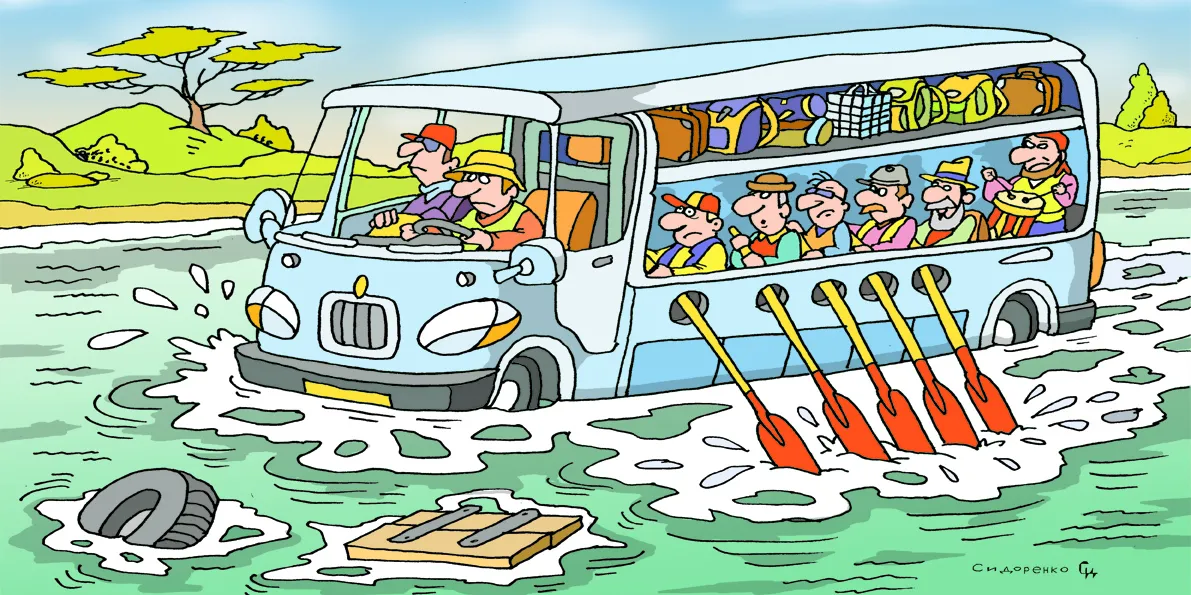
Cartoon by Olexandr Sydorenko.
Recently, one of "Gromada's" editors was returning from a business trip to the region. A routine trip on an inter-district bus turned into a session of "shock therapy." While passengers were habitually grumbling about the latest price hike — by a full ten hryvnias — he began to wonder: has there been even a single situation in our recent history where, after market stabilization, the fare returned to its previous level?
We know the answer: in our country, the tariff moves in only one direction. And that direction is up. Even when oil quotes settle down and inflation in National Bank reports begins to pleasantly please the eye, the digits on the minibus windshields remain unchanged.
Why does this happen, and where is the line beyond which transport becomes a luxury?
Summary
The article investigates the systemic issues behind the continuous rise of suburban bus fares in the Kharkiv region. It contrasts the Ukrainian "wild market" model, where passengers bear the full cost of fuel, repairs, and corruption risks, with the European model (using Wroclaw as an example) where transport is a subsidized social service.
Key findings highlight that fares remain high due to a lack of transparent passenger accounting, delayed government subsidies for privileged categories, and a deep-seated distrust between private carriers and local authorities. The piece concludes that stable, high-quality transportation is impossible without budgetary co-financing and a transition from cash-based operations to "per-kilometer" service contracts.
Read more in the Ukrainian edition....

Comments
Some more relevant news for now