




















Tears of Bronze: Why Those Who Remembered World War II Would Be Horrified Today
Blogs | 23 June, 2026 at 17:44 | 2,610 | Author: Olena Zelenina
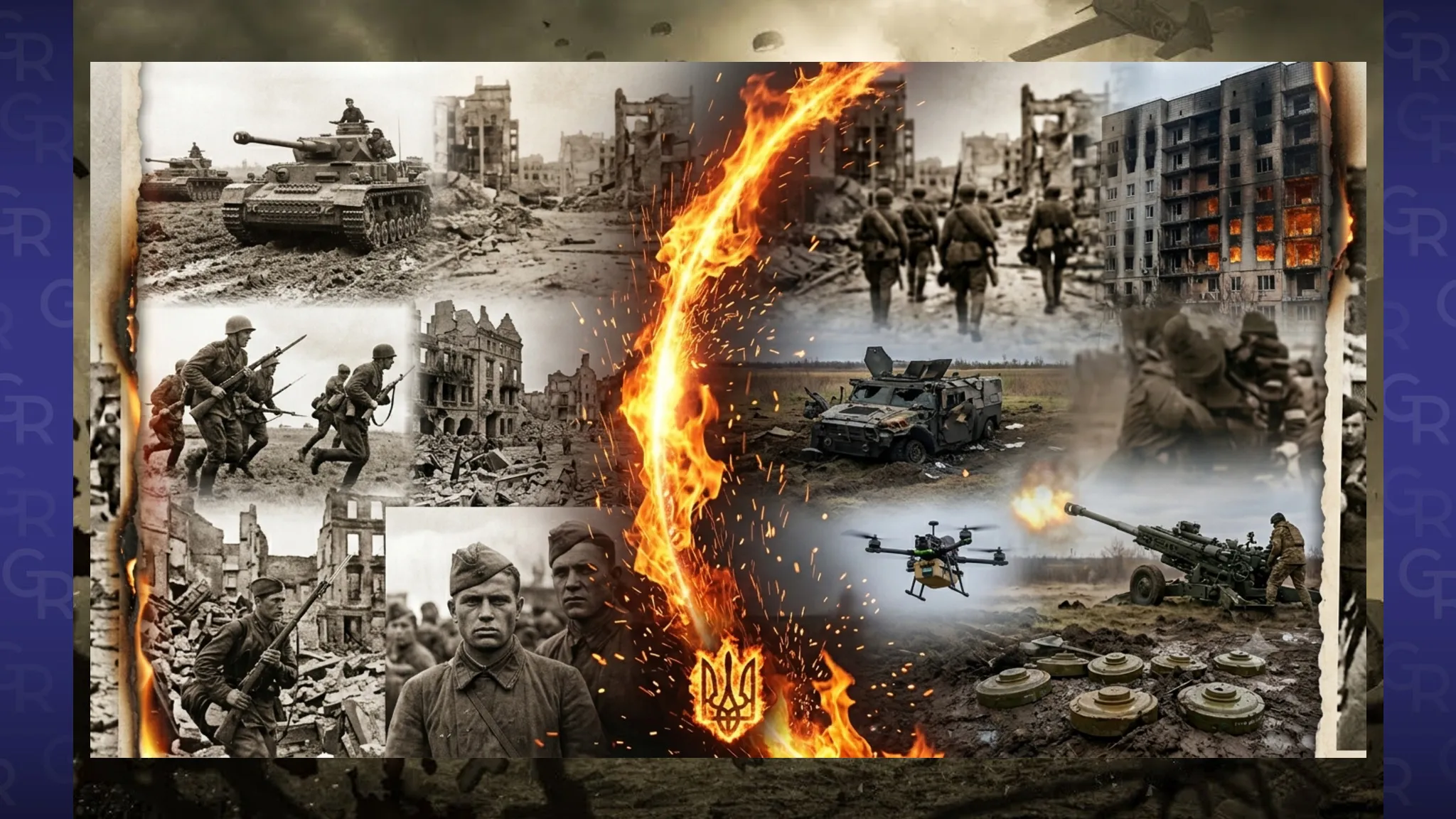
Collage created with Gemini/ Idea by Olena Zelenina.
Yesterday marked another anniversary of the beginning of that old war, which was once called the "Great Patriotic War." But I remember March 2022. An endless, exhausting traffic jam. In the car—children, my granddaughter. All around—a gray, anxious sky and wet, sticky snow. Outside the window, a monument to a Soviet soldier on a mass grave of fallen warriors slowly drifted by. The snow was melting on his metal cheeks and flowing down, leaving dark paths. It seemed as if this bronze soldier was crying.
Crying from unutterable pity for us, his descendants, and from the realization of a terrible truth: their colossal sacrifices in the fight against Nazism did not save the world. Europe is on fire again.
Today, people often try to compare that war and the current one. But the truth is that anyone who romanticizes the past or measures the present nightmare by the templates of the middle of the last century simply has no idea what modern war is. What we are experiencing now, in its cynicism, technological advancement, and the scale of destruction of the human psyche, has turned out to be far more terrible.
The old war had a clear, albeit terrible, geometry. There was a front where the fate of battles was decided, and there was a rear—yes, hungry, cold, under bombs, but a rear where people could live and work for victory. Today, the concept of the "rear" has been completely destroyed. A Russian rocket or a kamikaze drone, launched from a thousand kilometers away, destroys a children's hospital in Kyiv or a residential high-rise in Uman or Kharkiv in the dead of night. Modern technologies have made death detached and mundane. Back then, to kill, the enemy had to see you through a crosshair or fly over your city. Now, the killer sits in a cozy office on the other side of the continent, sips coffee, and simply presses a button on a computer, directing ballistics at sleeping neighborhoods. This is a war without a face, a mechanized slaughter, where a human being is reduced to a pixel on a UAV operator's screen.
But the most terrible fracture occurred in the realm of morality. In World War II, it was clear where the absolute evil was, and where the rest of the world was, uniting against it. Now, the very one who once shouted the loudest "never again" and appropriated the right of the sole "victor over Nazism" has itself put on the executioner's uniform. Russia has turned the memory of that tragedy into fuel for new aggression. The exact same cities that Soviet soldiers defended in 1941 are today being wiped off the face of the earth by Russian artillery. Mariupol, Bakhmut, Vovchansk—these are not just ruins, these are cemeteries compared to which some destructions of the past seem local. Back then, cities were rebuilt because walls remained. Today, KABs (guided aerial bombs) and "Iskanders" turn concrete and brick into dust, leaving not even foundations.
And, of course, the ecological dimension, which people in the forties did not even think about. The earth back then suffered from trenches and shell casings, but it came back to life. Now we are dealing with ecocide on a planetary scale. The blowing up of the Kakhovka Hydroelectric Power Plant is not just a military maneuver; it is the instantaneous destruction of an entire ecosystem, comparable to a natural cataclysm. Modern chemistry, toxic rocket fuel, millions of mines that will poison our black soil for decades, the scorched protected forests of the Kinburn Spit and Kreminna—this war kills the future at the biological and geological levels.
Therefore, that bronze soldier in the wet March snow truly had a reason for tears. He and millions of his comrades died hoping that their children would never hear the sound of an air raid siren. They left us a peace that we could not maintain, because evil has evolved, learned to use smartphones, high-precision weapons, and manipulate history. And today, we are forced to finish their work—but already in the conditions of a much more treacherous and cruel twenty-first century.

Comments
Some more relevant news for now