


























Top PSYOPs of the Week (Sep 7–13, 2026): "Encirclement of Troops" Near Kharkiv. From Brussels Manicures to an Aspen Stake for Dracula
Articles | 13 September, 2026 at 8:35 | 1,158 | Author: Olena Zelenina, Olexandr Sydorenko (caricature)
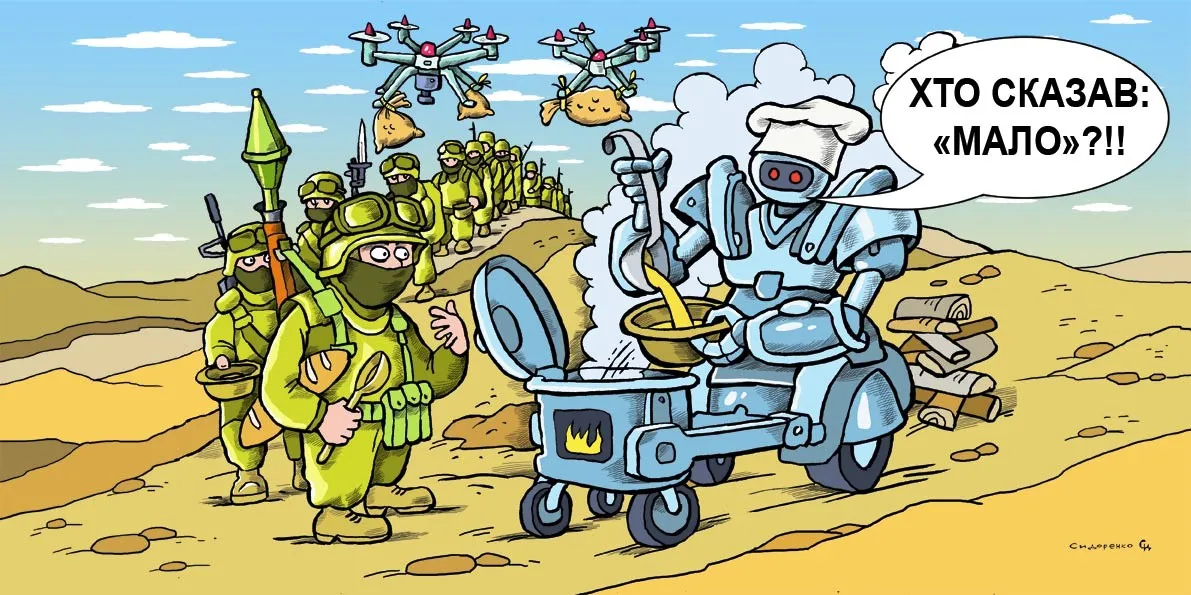
Cartoon by Olexandr Sydorenko.
— Two Kremlin trolls meet in Brussels. One says exhaustedly: — Listen, I’ve already churned out 300 articles about how the EU "demands mandatory mobilization of women in Kharkiv." Do you think the women in Kharkiv are panicking yet?
— Yeah, panicking... Yesterday, one of them read our fake news and asked: "Does your Brussels body armor match a nude manicure better, or a 'milky french'?"
And this isn't just humor. The women of Kharkiv have long proven that they are not only the most beautiful, but also the bravest and most resilient in Ukraine.
Under constant shelling, they hold down the home front, volunteer, keep businesses running, and raise children. Therefore, the naive attempts of Russian trolls to scare them with another primitive fabrication evoke nothing but genuine laughter in Kharkiv.
English Summary
"Brussels Body Armor" to Match a "Milky French" (EU Mobilization Fake): On September 10, the Center for Strategic Communications tracked nearly 300 FIMI-network publications falsely claiming the EU demanded Kyiv initiate forced mobilization of women and mass refugee returns. Blending Russian Foreign Intelligence Service (SVR) statements with domestic discussions, the campaign aimed to portray the West as treating Ukrainians purely as "human resources," trigger fear of deportation, and demoralize women holding together cities like Kharkiv. The EU has zero authority over Ukraine's mobilization laws, and expert discussions were manipulated into a fake external ultimatum.
"Virtual Cauldrons" for the State Duma Elections (Kharkiv Encirclement Fake): Russia’s Ministry of Defense claimed to have encircled 1,700–2,000 Ukrainian troops across 460 square kilometers in northeastern Kharkiv Oblast. Independent analysts (including ISW) and military evidence debunk the claim as pure information pressure. In modern drone-driven warfare, operations are executed by small tactical groups, making a single localized "encirclement" of 2,000 soldiers a tactical impossibility. Russia's state media has repeatedly fabricated identical "cauldrons" (near Bakhmut, Avdiivka, and Vovchansk) over the past two years. This latest campaign serves as a pre-election PR stunt ahead of Russia's State Duma elections to simulate grand strategic victories and distract from heavy battlefield losses.
"Secret Deficit" vs. War Costs (The NYT Article Breakdown): The review analyzes how domestic commentators distorted a New York Times report on Ukraine's $27B defense funding gap. While manipulators framed it as corruption, NYT actually explained the real causes: delays in Western arms deliveries forced Ukraine to buy weapon systems directly with domestic funds, expanded mobilization increased personnel costs, and strict rules prevent Western budget aid from being spent on the military. The text highlights how internal political infighting inflates these working deficits into scandals, inadvertently aiding Russian propaganda.
Targeting Kharkiv Gas Stations (Infrastructure Terror Fake): Debunking Russian panic-mongering around strikes on Kharkiv gas stations. The piece explains the engineering reality: fuel reservoirs are buried beneath meters of earth and heavy concrete slabs with zero oxygen inside, making underground explosion impossible via light drones and forcing aggressors to waste resources on surface terror.
Washington-Style "Buckwheat": Trump’s $5,000 Promise: Donald Trump’s campaign pledge to pay every adult American $5,000 upon a Republican congressional victory is analyzed as classic political populism. The segment exposes why it is unfeasible ($1.35 trillion cost, strict Congressional budget approval requirements, and inflation risks) and identifies it as a media distraction technique.
"Psychologist-Bone Setter" and the Pop-Culture "Anti-Ukrainian Cyst": A satirical take on singer Nastya Kamenskykh's interview claims that singing in Ukrainian caused her to develop a vocal cord cyst until a psychologist advised returning to Russian. The segment deconstructs this pseudo-medical excuse as a PR stunt to justify returning to Russian-language tours for money while feeding hostile narratives about Ukrainian culture.
Underground Champions: Cemetery Digging in Hungary: The finale mocks the international grave-digging championship in Hungary where Russia's team from Novosibirsk failed to reach target depths. Wrapping up with dark humor, it proposes adding an aspen-stake driving competition in historic Transylvania to permanently seal away the "Russian World."
Read more in the Ukrainian edition....

Comments
Some more relevant news for now